

Last surveyed: August 2026 (we checked each provider’s official site, terms of service and help centre ourselves). Prices and conditions change, so we re-check and update this article regularly.
Search for a travel eSIM and every site shouts “unlimited”. Yet travellers keep reporting the same thing: everything is fast on day one, then video stops loading. The reason is the FUP (Fair Usage Policy).
For this article we read the official pages, terms of service and help centres of six international providers ourselves, in August 2026. On top of that primary research, this guide now covers everything you are likely to wonder about before buying: how unlimited eSIMs work, what a 3GB daily cap actually buys you, how to choose by destination, and how to set one up and fix it when it will not connect — all in one page. Where a provider does not publish a figure, we say so instead of guessing.
What you will find below:
- Why “unlimited” plans slow down (how FUPs work)
- A six-provider table of daily caps, throttled speeds and tethering limits
- Four providers whose marketing contradicts their own terms of service
- What 3GB or 5GB a day really buys you, calculated from Netflix’s and Zoom’s official figures
- How to choose by destination and travel style, with prices in USD
- Setup steps, device compatibility checks and troubleshooting
What is an unlimited eSIM?
An eSIM (embedded SIM) is a digital SIM built into your phone. Instead of swapping a physical card, you scan a QR code or tap a link and a travel data plan is added to your device. No queueing at an airport kiosk, no tiny card to lose.
An “unlimited eSIM” is a plan sold without a total data allowance for the trip — the promise is that you can use maps, social apps and video without watching a gigabyte counter. The catch, and the subject of this article, is that the word “unlimited” means very different things depending on who sells it. Plans that throttle you after 2GB a day and plans with genuinely no cap are sold under the same label.
How unlimited eSIMs work
Most travel eSIMs are resold connectivity: an international operator interconnects with local networks and issues you a roaming profile. You install the profile, turn on data roaming at your destination, and traffic flows over a local carrier.
To manage congestion, most providers attach a daily high-speed allowance — typically 2 to 5GB — to their unlimited plans. That allowance, and the speed you get after it, is the real substance of an unlimited plan. It lives in the terms of service and help centre, and often does not appear on the landing page at all.
How does an eSIM compare with the alternatives?
- Carrier roaming — zero setup, but usually the most expensive option, often the equivalent of several dollars to ten dollars a day.
- A local physical SIM — can be cheap, but you queue at the airport, swap cards, and have to keep your home SIM safe for the whole trip.
- Pocket Wi-Fi rental — shareable, but you collect and return a device, and you now have one more battery to charge, at a daily rental fee.
- eSIM — installed at home before departure; at the destination you just switch on roaming. Nothing to collect, nothing to lose, and usually cheaper than any of the above. With tethering it replaces a pocket Wi-Fi too.
Four reasons travellers pick unlimited
1. No gigabyte anxiety
With a fixed-data plan, part of your brain spends the whole trip tracking the remaining balance — hesitating before opening a video, pausing photo backups, rationing map searches. A genuinely uncapped plan removes that entirely: you use your phone abroad the way you use it at home.
2. No surprise roaming bills
eSIMs are prepaid. The price you see at checkout is the whole cost, which matters especially when you are buying for a family.
3. Tethering for laptops and companions
Your phone becomes the hotspot for a laptop, tablet or a travel companion’s phone. But as this survey shows, some providers cap tethering separately, so check that line before relying on it. Our Truly Unlimited plans have no tethering cap.
4. Connected from the moment you land
Install before you leave, switch on roaming when you land. The moment you most want data — calling a ride, telling family you arrived — is exactly when it already works.
The honest downsides
- FUPs. The headline problem: “unlimited” on the label does not mean uncapped in the terms.
- Your phone must support eSIM and must be carrier-unlocked (how to check comes later in this guide).
- Usually data-only. No phone number unless you choose a plan that includes one.
- Activation deadlines. Most plans must be started within a set period after purchase — check the product page.
- A little setup. Two steps — install, then switch on roaming. A few minutes, but not zero.
What is a Fair Usage Policy (FUP)?
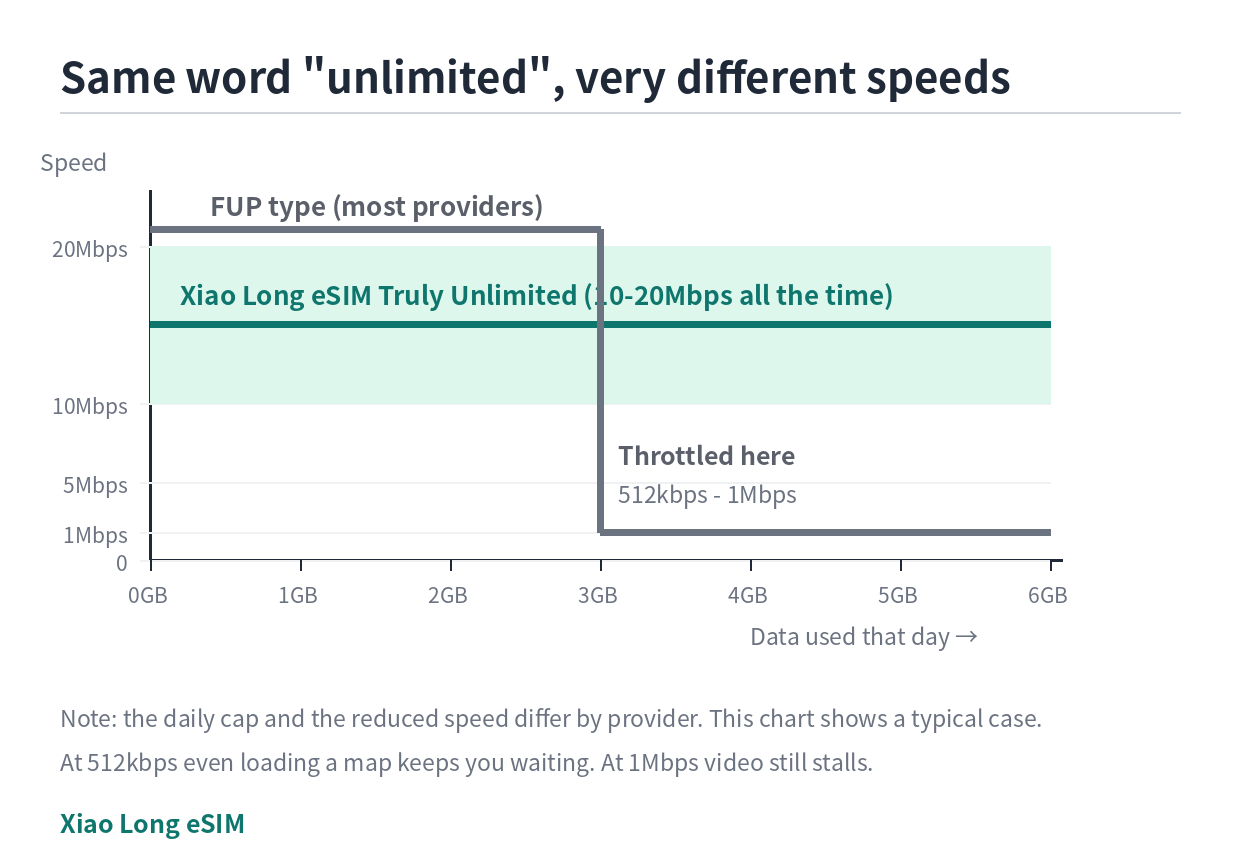
An FUP is a clause that says: even on an unlimited plan, once you use a certain amount, your speed is reduced. Most providers set a daily high-speed allowance of 2 to 5 GB, then throttle you to somewhere between 512kbps and 3Mbps.
So most “unlimited” plans are really “fast for the first few gigabytes, then capped in practice”. Your data is never cut off, which is how the word “unlimited” is justified, but the experience is completely different. The surest check is to search the provider’s terms and help centre for “FUP” or “Fair Usage” — which is exactly how this survey was done.
Why does an unlimited plan slow down partway through?
Because the daily high-speed allowance ran out. Most plans refresh it every 24 hours, so the pattern is not “day one was fine, day two was slow” but “every day, it slows down once I pass a few gigabytes”. The reset point differs by provider: some count 24 hours from activation, others reset at local midnight.
How we did this survey
We opened each provider’s product pages, terms of service and help centre directly, and searched them for “FUP”, “Fair Usage”, “speed”, “throttle” and “tethering”. We did not use figures from comparison blogs — in fact, one widely-quoted figure about Holafly could not be found anywhere on Holafly’s own site (details below). Where two official pages of the same provider disagreed, we recorded both. Where nothing was published, we wrote “not published” rather than guessing, because the absence of a number is itself something you should know before buying.
What six providers actually say
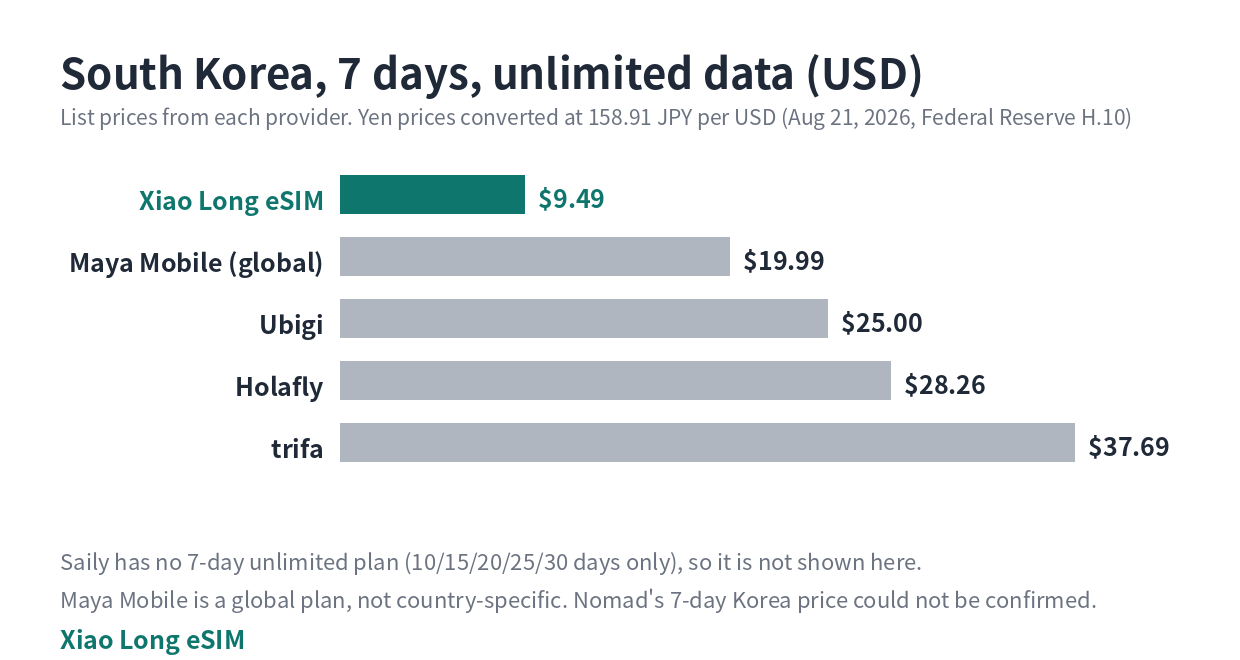
Prices are for South Korea, 7 days, unlimited data. Yen prices are converted at 158.91 JPY per USD (21 August 2026, Federal Reserve H.10).
| Provider | Korea, 7 days | Daily high-speed cap | Speed after the cap | Tethering |
|---|---|---|---|---|
| Xiao Long eSIM | $9.49 | None | No throttling, 10-20Mbps throughout | Unlimited |
| Maya Mobile (global plan) | $19.99 | 5GB | 3Mbps | Allowed |
| Ubigi | $25.00 | 25GB for the period | 2Mbps | Allowed |
| Holafly | $28.26 | Not published | Not published | 1GB per day |
| trifa | $37.69 | States there is none | Not applicable | Allowed, varies by plan |
| Nomad | Korea 7-day price not confirmed | 2GB | 512kbps | Allowed |
| Saily | No 7-day plan | 3GB or 5GB | 1Mbps | Terms and marketing disagree |
Provider by provider
Holafly
We could not find a published daily cap. The terms say there is no fixed data limit but that coverage and speed may be subject to the network provider’s fair usage policy. What is stated clearly is that tethering is limited to 1GB per day, so a 7-day plan shares 7GB in total. Up to 90 days, 200+ destinations, 24/7 support in Japanese. Korea and Japan are both 4,490 yen for 7 days.
A figure of “90GB per month, then 256-1024kbps” circulates in comparison articles. We searched Holafly’s own pages and terms directly and could not find it. It appears to originate from a competitor’s article, so we do not use it here.
trifa
trifa states in its own column that it does not set a daily allowance, so speed does not drop for that reason. Tethering has no volume cap, though support varies by plan. Japanese-speaking staff answer chat 24/7. The trade-off is price: 5,990 yen for 7 days in both Korea and Japan, roughly four times ours. Unlimited plans run up to 31 days.
Maya Mobile
The product data on the current global plans states 5GB per day at full speed, then 3Mbps. A separate help centre article still describes the older scheme: 3GB per day, then 10Mbps, dropping to 1Mbps under sustained heavy use, cleared within 24 hours. 165+ countries. No Japanese pages or Japanese support.
Ubigi
Ubigi works differently: the allowance is a total for the period, not per day. Korea 7 days is 25GB, Japan 15 days is 30GB and 30 days is 60GB, after which you get 2Mbps. Its blog also says a daily-FUP version with 5GB per day is being rolled out to selected destinations. 200+ destinations.
Nomad
2GB per day, then throttled. Japan unlimited runs to a maximum of 21 days, at 3,974 yen for 7 days. 200+ destinations.
Saily
Saily’s terms are the clearest of the six: a daily full-speed allocation of either 3GB or 5GB depending on the destination, then 1Mbps for the rest of the period, with the allowance resetting at local midnight. Japan and the United States are 5GB per day. There is no 7-day unlimited plan — you choose 10, 15, 20, 25 or 30 days. Japan is $48.99 for 15 days and $71.99 for 30 days.
Four providers contradict themselves
This is the part worth knowing before you buy. In four cases the marketing page and the contract do not agree.
- Maya Mobile — the FAQ says “Really unlimited. Maya never throttles or caps your speed.” The terms of service on the same site say a daily quota exists and that speeds after it are not guaranteed. The product data says 5GB per day, then 3Mbps.
- Saily — country pages advertise hotspot sharing with no restrictions, while the terms list “excessive tethering or sharing of data via hotspot beyond occasional personal use” as a prohibited activity.
- Nomad — the plan document says 512kbps after the daily allowance; the help centre says roughly 1 to 2Mbps. The two official sources disagree.
- Ubigi — the Korea 7-day product page says 25GB; the blog table says 20GB for 7 days.
Is tethering capped too?
Sometimes, yes. Data on the phone can be unlimited while the hotspot has its own separate cap. In this survey Holafly states a 1GB per day tethering limit, which is 7GB in total on a 7-day plan. If you plan to work from a laptop or share with a travel companion, check this line specifically.
What does 3GB or 5GB a day actually buy you?
A fair question — maybe 3GB is plenty? Let us convert it using figures the services themselves publish.
Netflix’s official help centre says streaming uses up to 1GB per hour at standard definition and up to 3GB per hour in HD; the mobile app’s data-saver setting stretches 1GB to about 4 hours. So a 3GB daily allowance disappears like this:
- About 1 hour of HD video
- About 3 hours at standard definition
- Roughly 12 hours on the mobile data-saver setting
Video calls: Zoom’s official requirements are 2.6Mbps for 720p group calls and 3.8Mbps for 1080p, and an hour of group video can consume on the order of a gigabyte. Two meetings a day and the 3GB cap is in sight.
Maps, messaging and text-centric social feeds, on the other hand, rarely exhaust 3GB. In short:
- Usually fine on a capped plan — navigation, messaging, searches, browsing text-centric feeds
- Likely to hit the cap — streaming video, video calls, tethering a laptop, automatic photo and video backups, sharing your connection with companions
One trap deserves a mention: automatic photo backups. You shoot far more on holiday, and gigabytes can vanish in the background while you think you have barely used the phone. If a capped plan mysteriously slows down every evening, this is usually why.
What do 512kbps, 1Mbps and 3Mbps feel like?
- 512kbps — even reloading a map keeps you waiting; photos crawl; video barely plays. Zoom’s own minimum for high-quality video is 600kbps, so video calls do not work. Text messaging is the practical ceiling.
- 1Mbps — text-centric use is tolerable, image-heavy pages are slow, video stalls even at low quality. Not enough for 720p group calls (2.6Mbps).
- 2-3Mbps — standard-definition video mostly works; HD does not; large transfers take time.
- 10-20Mbps — HD video, video calls, maps and social apps all work, with headroom above Zoom’s 1080p requirement (3.8Mbps). Our Truly Unlimited plans hold this range regardless of how much you have used (carrier-official plans excepted).
Who needs unlimited, and who is fine with fixed data?
Choose uncapped unlimited if you stream video, take video calls, tether a laptop, share with family, or back up photos and videos as you go. The value is never having to think about the balance.
Fixed data is enough if your trip is maps and messages, with video saved for hotel Wi-Fi. If you normally use 1-2GB a day, a fixed plan is usually cheaper. We sell those too: the High-Speed Data Pack (a total allowance for the period) and the Daily Data Refresh Plan (a daily allowance that resets every day), from 500MB up to 50GB.
Where data actually matters on a trip
- Maps and navigation — open almost constantly in an unfamiliar city.
- Translation — camera and voice translation need a connection right when you need them most.
- Ride-hailing — the first thing you open after landing.
- Keeping in touch — arrival messages, meeting up with companions, posting photos (which is where usage jumps).
- Mobile payments and tickets — QR payments, e-tickets, check-ins.
- Video and music — the main data consumer, and the first thing to exhaust a capped plan.
Any plan covers the first five. The fork in the road is video and tethering — if you use those, you want unlimited.
Our three plan types
Truly Unlimited Plan
No daily high-speed cap; no slowdown however much you use; 10-20Mbps throughout (carrier-official plans excepted); tethering unlimited too. For streamers, business travellers and anyone who shares their connection.
Daily Data Refresh Plan
A daily high-speed allowance (choose 500MB to 10GB) that resets every day. After the allowance the speed drops — to a value we print on every product page as “FUP xMbps” — and recovers the next day. Cheaper than unlimited if your daily usage is predictable.
High-Speed Data Pack
A total allowance for the whole period (500MB to 50GB), to spend as you like. The cheapest option for light use.
All three types support tethering, and most destinations offer day counts from 1 to 30 days so you do not pay for days you will not use (available day counts vary by destination).
Choosing by travel style
Weekend and short trips (2-4 days)
For short stays, ease and reliability matter more than the per-day rate. Our Truly Unlimited plans start from 1 day — Korea from about $1.36 a day.
Business trips
Video calls plus laptop tethering will blow through a 2-5GB daily cap. Pick a plan with no daily cap and no separate tethering limit — in the table above, that means a blank in the “tethering cap” department.
Long stays and workations
Beyond two weeks, maximum durations matter: trifa 31 days, Maya Mobile, Saily and Ubigi 30 days, Holafly 90 days. Our Truly Unlimited plans run up to 30 days, selectable from 1 day at most destinations.
Family and group travel
Either everyone gets an eSIM, or one unlimited line is shared by tethering. If you share, the tethering cap is decisive — a 1GB-a-day limit cannot carry a family. Ours has no tethering cap, so one parent’s phone can carry the children’s devices.
Choosing by destination
All prices below are our Truly Unlimited 7-day plans in USD.
South Korea
$9.49 for 7 days (about $1.36 a day), with day counts from 1 to 30. A phone-number plan on the official SKT network is also available separately.
Japan
$12.38 for 7 days. Popular with overseas residents visiting home; no identity verification is required.
Taiwan
$13.89 for 7 days. Speed does not drop with usage, so it stays steady even through a night-market evening of photos and messages.
Mainland China
A plan covering China, Hong Kong and Macau together is $16.97 for 7 days. Because it runs as international roaming, Google, LINE and social apps work without a VPN — the classic China-trip headache solved.
United States
$15.89 for 7 days. A carrier-official T-Mobile plan with a US phone number is $8.67 for 7 days, handy if you need local calls and SMS.
Europe
A 41-country plan is $18.97 for 7 days, switching networks automatically as you cross borders — no rebuying mid-itinerary.
Southeast Asia
A 5-country plan covering Singapore, Malaysia, Thailand and more is $13.93 for 7 days; single-country plans are also available.
Middle East
Saudi Arabia is $35.31 for 7 days; an 8-country Middle East plan covering Saudi Arabia, the UAE, Qatar and more is $38.51.
Hong Kong & Macau / Australia
Hong Kong & Macau is $14.59, Australia $14.85, both for 7 days with day counts from 1 day.
What makes Xiao Long eSIM different?
- No daily high-speed cap. However many gigabytes you use, we do not slow you down because of the volume you used.
- 10-20Mbps the whole time (except carrier-official plans). Not fast at first and slow later — the same speed from the first day to the last.
- Tethering is unlimited too. There is no separate 1GB-a-day style cap.
- 190+ countries and regions, including multi-country plans.
- And it is among the cheapest for most destinations.
Steady speed, unlimited tethering, 190+ destinations, and this price — as far as our research goes, we did not find another eSIM that delivers all four at once.
Our 7-day Truly Unlimited plans
| Destination | 7 days | Per day |
|---|---|---|
| South Korea | $9.49 | $1.36 |
| Japan | $12.38 | $1.77 |
| Indonesia | $13.62 | $1.95 |
| Taiwan | $13.89 | $1.98 |
| Southeast Asia (5 countries) | $13.93 | $1.99 |
| Hong Kong & Macau | $14.59 | $2.08 |
| Australia | $14.85 | $2.12 |
| United States | $15.89 | $2.27 |
| China, Hong Kong & Macau | $16.97 | $2.42 |
| Europe (41 countries) | $18.97 | $2.71 |
How to choose without getting caught out
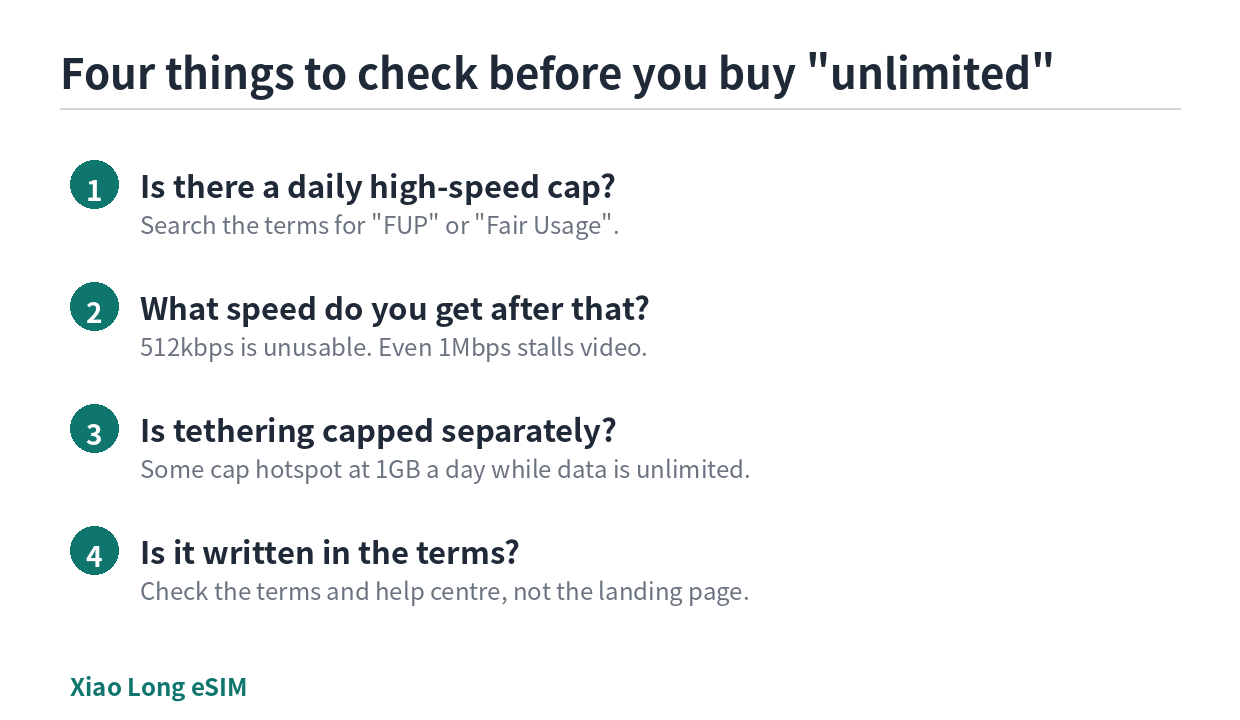
- Is there a daily high-speed cap? Search the terms for “FUP” or “Fair Usage”.
- What speed applies afterwards? At 512kbps even a map keeps you waiting. At 1Mbps video still stalls.
- Is tethering capped separately? Data can be unlimited while the hotspot is capped at 1GB a day.
- Is the condition written in the terms? Read the terms and the help centre, not the landing page. Four of the six providers we checked contradict their own marketing.
How many days should you buy?
Most plans start counting when the eSIM first connects to a network at the destination — arrival day is day one. So the baseline is simply the number of days you are there. Edge cases worth a thought: a post-midnight arrival or a late departure may add a day; if you want data at a stopover, check that the country is on the plan’s coverage list; and if your dates might change, note that unused (never-connected) eSIMs can be cancelled and refunded within 60 days of purchase (carrier-official plans excepted), so buying early is low-risk.
Your eSIM info page
After purchase we email you a link to your eSIM setup and info page, which holds the quick-install link, QR code and activation code, plus live data usage, validity and APN details. No app to install — checking how much you have used is one tap.
Pocket Wi-Fi or unlimited eSIM?
| Unlimited eSIM | Pocket Wi-Fi rental | |
|---|---|---|
| Pick-up / return | Not needed (arrives by email) | Airport counter etc. |
| Extra luggage | None | Device + charger |
| Charging | Phone only | The Wi-Fi unit too |
| Sharing | Via tethering | Yes |
| Loss / damage | No risk | Penalty fees possible |
| Typical cost | Korea 7 days from $9.49 | Several dollars per day |
If your phone supports eSIM, the eSIM wins on every logistics point, and tethering covers the sharing use case (pick a plan without a tethering cap). Pocket Wi-Fi still makes sense for non-eSIM phones or large groups sharing one line all day.
From purchase to connection in three steps
Step 1: Buy a plan
Choose your destination, data amount and day count in our shop and pay (credit and debit cards, Apple Pay, Google Pay, PayPal and USDT are accepted). Your eSIM profile — quick-install link, QR code and activation code — arrives by email, along with the info page for usage and validity.
Step 2: Install before you leave
On iOS 17.4+ or Android 10+, the quick-install link is the easiest way: tap it and the eSIM installs automatically. Scanning the QR code works too. Do this at home on Wi-Fi. Installing does not start the clock, and at this point cancellation and refund are still possible.
Step 3: Activate on arrival
At your destination, enable the eSIM in settings and turn on data roaming — this is the step people miss. Most plans start counting when you first connect. Once traffic flows, the plan can no longer be cancelled or refunded.
Checking that your phone supports eSIM
- Dial *#06#. If an EID appears on screen, your phone supports eSIM; if you only see IMEIs, it does not.
- On iPhone and iPad: Settings → General → About — an “EID” row means eSIM support.
- The phone must be carrier-unlocked.
- Support can differ by sales region for the same model: iPhones sold in mainland China (and dual-physical-SIM models from Hong Kong and Macau) do not support eSIM, and Google Pixels sold in Hong Kong do not either. Always run the *#06# check even if your model is on a compatibility list.
When it will not connect
- Check that data roaming is on. This is by far the most common cause.
- Check that the eSIM line itself is enabled.
- Toggle aeroplane mode; if that fails, restart the phone.
- Try resetting network settings.
- For Japan-bound eSIMs only, a small number of Android phones need the APN set manually to the value shown on your eSIM info page. iPhones configure automatically. If you are already connected, do not change the APN.
If installation itself fails, try the methods in order: quick-install link, then QR code, then manual entry of the activation code. And if you are still stuck, contact our support by chat or email and we will walk through it with you.
Checking data balance and validity
Your eSIM info page (linked in the delivery email) shows live data usage and the validity period at any time, with no app required. Other providers vary — some use an app, some a web account page.
When the clock starts, and refunds
Most plans: install at home, and the day count starts when the eSIM first connects at the destination. Timing does vary by plan — global plans that include your home country may start when they touch your home network, and some plans use a start date you pick at purchase — so check the product page.
We accept cancellation and refund within 60 days of purchase while the eSIM is unused (never activated). Carrier-official plans (SKT, AIS, Vodafone Australia, Orange, US T-Mobile and similar) cannot be cancelled or refunded even unused, per the carriers’ rules; these are clearly marked on their product pages.
Frequently asked questions
What is an eSIM?
An embedded SIM built into your phone. You add a data plan by scanning a QR code or tapping a link — no physical card to swap.
Which countries do you cover?
We offer plans for 190+ countries and regions: single-country plans, regional plans for Asia, Europe, the Middle East and South America, and global plans covering 118-208 countries (coverage varies by plan; the exact list is on each product page).
What payment methods do you accept?
PayPal (credit and debit cards), Apple Pay, Google Pay and USDT.
Does a 3GB or 5GB daily cap actually matter?
It depends how you travel. Maps and messaging usually fit. Streaming video, video calls, tethering a laptop, or backing up photos and video will not, and once you hit the cap you spend the rest of that period on a slow connection. The advantage of having no cap is that you never have to think about it.
Once throttled, am I slow for the rest of the trip?
Usually the high-speed allowance returns after 24 hours, but the reset point differs: some providers count 24 hours from activation, others reset at local midnight. Until then you stay on the reduced speed.
If it says “unlimited”, are the terms unlimited too?
Not necessarily. In this survey one provider states on its FAQ that it never throttles, while its own terms of service describe a daily quota. Read the terms and the help centre before you decide.
How is the Truly Unlimited Plan different from the Daily Data Refresh Plan?
Truly Unlimited has no daily cap at all. Daily Data Refresh gives you a fixed high-speed allowance each day (500MB to 10GB, your choice); after it, the speed drops to the “FUP xMbps” value printed on the product page, then recovers the next day. Predictable usage: Daily Refresh is cheaper. Unpredictable or heavy usage: Truly Unlimited.
What does “FUP xMbps” mean on your product pages?
The maximum speed after the high-speed allowance is used up. We print it on every capped plan so you know before buying exactly what happens after the cap.
Can I tether?
Yes — every plan we sell supports tethering. Truly Unlimited plans have no tethering volume cap, unlike the “1GB per day” limits seen elsewhere.
Does 5G work?
On most plans, yes, where the local network and your phone support it. A few plans and regions are 4G-only per local carrier policy; each product page says which. 4G/LTE is comfortably fast for video and calls.
Do I get a phone number?
Plans are data-only by default; use LINE, WhatsApp and similar for calls. If you need a number, we offer phone-number plans on official carrier networks: Orange (Europe/global), SKT (Korea), AIS (Thailand) and T-Mobile (US).
Do Google and LINE work in mainland China?
Yes. Our mainland China plans run as international roaming, so Google, LINE and social apps work without a VPN.
Can I keep several eSIMs on my phone?
On many models, yes — install several and switch between them. How many can be active at once depends on the model and sales region.
When should I install?
Before departure, on home Wi-Fi. Installation alone does not start the clock on most plans (check your product page for the exact start condition).
What about multi-country itineraries?
Regional and global plans cover many countries on one eSIM, switching networks automatically at borders. Check that every country on your route is in the plan’s coverage list.
Do messages still work when throttled?
Text messaging generally works even around 512kbps. Photos and videos crawl, and voice or video calls may be unstable.
How long is the eSIM valid?
It varies by plan. Most must be activated within a set period after purchase (for example 60 days); after activation you have the plan’s day count. The exact terms are on the product page and your eSIM info page.
Physical SIM or eSIM?
If your phone supports eSIM, the eSIM usually wins on convenience, price and safety: nothing to collect, nothing to lose, and your home SIM stays in place. A physical SIM or pocket Wi-Fi remains the fallback for non-eSIM phones.
In short
“Unlimited” means very different things depending on who sells it. 2GB a day then 512kbps, 5GB a day then 3Mbps, or unlimited data with the hotspot capped at 1GB a day — all of these are sold as unlimited. Read the terms, not the landing page.
Our Truly Unlimited plans have no daily cap, run at 10-20Mbps throughout, and include unlimited tethering, at $9.49 for 7 days in South Korea — the lowest price among the providers we checked.
See the South Korea Truly Unlimited plan
See the Japan Truly Unlimited plan
Browse all destinations
Sources
Everything stated about other providers was checked directly against their official sites, terms of service and help centres in August 2026:
- Holafly — terms and conditions, Korea and Japan plan pages (esim.holafly.com)
- trifa — official column and terms of service (trifa.co)
- Maya Mobile — terms, acceptable use policy and help centre (maya.net, help.maya.net)
- Ubigi — plan pages and official blog (cellulardata.ubigi.com)
- Nomad — data plan documents and help centre (nomadesim.com)
- Saily — terms of service and country pages (saily.com)
- Netflix — official help centre, “How to control how much data Netflix uses” (help.netflix.com)
- Zoom — official support, bandwidth requirements (support.zoom.com)
Conditions change. Always confirm the current terms on each provider’s own site. USD conversions use the Federal Reserve H.10 rate of 158.91 JPY per USD for 21 August 2026.